How to Make Money on AI Datacenters
Artificial intelligence is transforming industries at a pace rarely seen in modern history. Behind every AI model, chatbot, autonomous vehicle, and recommendation engine is one essential piece of infrastructure: the data center. As demand for AI computing explodes, investors are increasingly looking for ways to profit from this long-term trend. Unlike investing directly in AI software companies, investing in AI data centers allows investors to benefit from the infrastructure powering the entire AI ecosystem. Here's how investors can capitalize on this opportunity. I purchased 10 of what I considered the best AI stocks last year and 8 of them performed really well. In Texas (as across the nation), we have many AI data centers being built. The typical data center has an Electric Power generator running off of gas to help lower the high electricity consumption. So there are many ways to make money on this type of investment.
David Parham
7/16/20268 min read
How to Make Money Investing in AI Data Centers
After a week, I have decided against buying invesments on AI Datacenters. Read the Negatives in this weeks article.
Artificial intelligence is transforming industries at a pace rarely seen in modern history. Behind every AI model, chatbot, autonomous vehicle, and recommendation engine is one essential piece of infrastructure: the data center. As demand for AI computing explodes, investors are increasingly looking for ways to profit from this long-term trend.
Unlike investing directly in AI software companies, investing in AI data centers allows investors to benefit from the infrastructure powering the entire AI ecosystem. Here's how investors can capitalize on this opportunity.
I purchased 10 of what I considered the best AI stocks last year and 8 of them performed really well. In Texas (as across the nation), we have many AI data centers being built. The typical data center has an Electric Power generator running off of gas to help lower the high electricity consumption. So there are many ways to make money on this type of investment.
Why AI Data Centers Matter
AI models require enormous computing power. Training a large language model can require tens of thousands of graphics processing units (GPUs) operating continuously for weeks or months. Running these models for millions of users also demands significant computing capacity.
This has created unprecedented demand for:
Hyperscale data centers
High-performance networking
Advanced cooling systems
Massive electrical power infrastructure
Fiber-optic connectivity
Industry analysts expect billions of dollars to be invested annually in AI infrastructure over the coming decade.
When I first started looking at Datacenter ETFs, the first one I found was DTCR. It only costs around $28 a share when I purchased it, and in two weeks it has gone up about 10%.
A further study on AI Datacenters also reviewed other ETFs you can purchase, which are listed a couple of pages below the DTCR article.
🏆 The Only Pure AI Datacenter ETF
DTCR — Global X Data Center & Digital Infrastructure ETF
What it owns: Companies that operate data centers and build digital infrastructure (REITs + fiber + interconnect + colocation). Why it matters: This is the closest thing to a “AI datacenter ETF” in existence. Source: DTCR invests in data center REITs and digital infrastructure firms supporting AI workloads .
Examples of holdings:
Equinix
Digital Realty
CyrusOne
CoreSite
Cell tower & fiber operators
If your goal is AI datacenter real estate + interconnect capacity, DTCR is the direct play.
🔧 Semiconductor ETFs (AI Datacenter Hardware)
These don’t own datacenters — they own the chips inside them. Still highly relevant to the AI datacenter boom.
SMH — VanEck Semiconductor ETF
Owns: NVIDIA, AMD, Broadcom, TSMC, ASML Why it matters: Semiconductors are the #1 cost driver of AI datacenter capex. Source: SMH tracks semiconductors powering AI data centers .
SOXX — iShares Semiconductor ETF
Owns: Similar to SMH but slightly broader. Source: SOXX holds chip designers and equipment suppliers central to AI datacenter build‑outs .
DRAM — Roundhill Memory ETF
Owns: SK Hynix, Samsung, Micron Why it matters: HBM memory is now a datacenter bottleneck. Source: DRAM is 75% concentrated in the three global HBM suppliers powering AI datacenters .
⚡ Power & Grid Infrastructure ETFs (AI Datacenter Energy Bottleneck)
AI datacenters are hitting power constraints — these ETFs capture that theme.
PAVE — Global X U.S. Infrastructure Development ETF
Owns: Quanta Services, Eaton, Trane, Sempra Why it matters: These companies build the electrical, cooling, and physical infrastructure for hyperscaler datacenters. Source: PAVE holds companies building the physical infrastructure for AI datacenters .
URA — Global X Uranium ETF
Owns: Uranium miners (Cameco, Kazatomprom) Why it matters: AI datacenter power demand is pushing nuclear back into mainstream investment. Source: URA is increasingly tied to AI datacenter electricity demand .
🧠 Broad AI Infrastructure ETFs (Full Stack Exposure)
These blend chips, cloud, and infrastructure.
AIQ — Global X Artificial Intelligence & Technology ETF
Owns: NVIDIA, AMD, TSMC, Microsoft, Oracle, Cisco Why it matters: High concentration in companies supplying AI datacenter hardware + cloud AI services. Source: AIQ has ~70% exposure to AI infrastructure (chips + cloud) .
AIPO — Defiance AI & Power Infrastructure ETF
Owns: AI hardware + power grid companies Why it matters: Combines AI compute + energy infrastructure — a hybrid datacenter play. Source: AIPO is listed as a top broad AI infrastructure ETF for the datacenter boom .
📌 Bottom Line
If you want pure AI datacenter exposure, the closest match is:
👉 DTCR
The only ETF explicitly focused on data center REITs & digital infrastructure.
If you want AI datacenter hardware, go with:
SMH / SOXX (chips)
DRAM (HBM memory)
If you want AI datacenter power infrastructure, consider:
PAVE
URA
🏆 The Only True AI Datacenter ETF
Global X Data Center & Digital Infrastructure ETF (DTCR)
Takeaway: DTCR is the closest thing to a pure AI datacenter ETF available today.
This is the only ETF whose mandate is literally “data centers & digital infrastructure.”
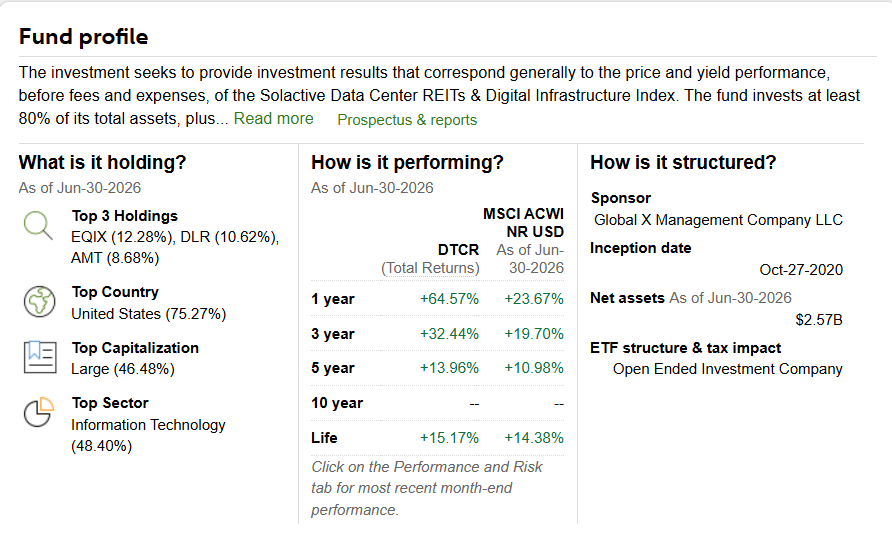
Below is a snippet of Fidelity Investments information I used when I purchased the ETF DTCR last week:
🧱 Other ETFs Adjacent to AI Datacenters
These are not pure datacenter ETFs, but they capture critical parts of the AI datacenter build‑out.
1. Semiconductors powering AI datacenters
SMH — NVIDIA, AMD, TSMC
SOXX — broader chip exposure
DRAM — HBM memory suppliers (Micron, SK Hynix)
2. Power & cooling infrastructure
PAVE — grid, electrical, cooling contractors
AIPO — AI + power infrastructure hybrid
3. Broad AI infrastructure
AIQ — AI chips + cloud hyperscalers
AIPO — AI compute + energy
👉 DTCR
The only ETF explicitly focused on data centers & digital infrastructure.
Five Ways to Invest
1. Buy Data Center REITs
Real Estate Investment Trusts (REITs) own and lease data centers to cloud providers, enterprises, and AI companies. As demand for AI computing grows, these companies benefit from higher occupancy rates and increased rental income.
Leading data center REITs include:
Digital Realty Trust (DLR)
Equinix (EQIX)
Advantages:
Stable recurring revenue
Attractive dividend income
Long-term customer contracts
Exposure to AI infrastructure growth
Risks include rising interest rates, construction costs, and increased competition.
2. Invest in GPU Manufacturers
No AI data center can operate without powerful GPUs.
Companies such as NVIDIA and AMD supply the chips that power AI training and inference.
Potential benefits:
Rapid revenue growth
High profit margins
Industry leadership
Potential risks:
Premium stock valuations
Cyclical semiconductor demand
Technological competition
3. Invest in Electric Utilities
Power has become one of the biggest bottlenecks facing AI data centers.
Many new facilities require hundreds of megawatts of electricity, creating opportunities for utilities that serve regions with significant data center construction.
Utilities may benefit from:
Increased electricity demand
Long-term commercial contracts
Infrastructure expansion
Some utilities also offer attractive dividend yields, providing investors with both income and growth potential.
4. Own Infrastructure Companies
Building AI data centers requires more than buildings.
Supporting infrastructure includes:
Power transformers
Electrical equipment
Cooling technology
Backup generators
Networking hardware
Fiber-optic systems
Companies supplying these products often experience strong revenue growth as data center construction accelerates.
5. Invest Through ETFs
Investors seeking diversification can use exchange-traded funds focused on:
Artificial intelligence
Semiconductors
Data centers
Digital infrastructure
Cloud computing
ETFs reduce company-specific risk while providing broad exposure to the AI ecosystem.
Income Investing Opportunities
Dividend investors need not miss out on AI growth.
Several infrastructure companies combine dependable dividends with exposure to expanding AI investment.
Potential candidates include:
Digital Realty Trust
American Tower
Crown Castle
Brookfield Infrastructure Partners
Selected electric utilities serving major AI development regions
These companies may provide a combination of current income and long-term capital appreciation.
Understanding the Risks
Despite the promising outlook, AI infrastructure investing is not risk-free.
Investors should consider:
High interest rates affecting REIT valuations
Technology changes that reduce hardware demand
Regulatory restrictions on energy usage
Power shortages delaying projects
Rapid changes in AI technology
Diversification remains essential.
Building an AI Infrastructure Portfolio
One example of a diversified AI infrastructure portfolio might include:
30% Data Center REITs
30% Semiconductor companies
20% Electric utilities
10% Infrastructure equipment manufacturers
10% AI-focused ETFs
This approach spreads risk across multiple segments of the AI infrastructure ecosystem.
Just looking at DLR for profitability:
When analyzing a REIT like Digital Realty Trust (NYSE: DLR), traditional net income is less meaningful because depreciation significantly reduces reported earnings. The key profitability metrics are Funds From Operations (FFO), Core FFO, Adjusted EBITDA, occupancy, leasing spreads, and dividend coverage.
Overall Profitability Rating: 9/10 (Excellent)
Digital Realty remains one of the strongest and most profitable data center REITs, benefiting from AI-driven demand, cloud computing, and enterprise digital infrastructure.
Revenue Growth — Excellent
Revenue continues to expand as hyperscale cloud providers and AI companies lease additional capacity.
2025 revenue grew approximately 14% year-over-year.
Management recently increased its 2026 revenue guidance, reflecting continued strong leasing activity. (Digital Realty Trust)
Grade: A
FFO Growth — Excellent
FFO is the primary measure of a REIT's operating profitability.
Recent results show:
Q4 2025 Core FFO: $1.86/share
2026 Core FFO guidance: $8.00–$8.10/share, increased from prior guidance. (Digital Realty Trust)
For a mature REIT, 6–8% annual FFO growth is considered very strong.
Grade: A
EBITDA and Operating Cash Generation — Excellent
Digital Realty generated:
Adjusted EBITDA of approximately $857 million in Q4 2025.
Full-year 2026 EBITDA guidance of $3.6–3.7 billion, with guidance subsequently raised. (Digital Realty Trust)
High EBITDA supports both development spending and dividend payments.
Grade: A
Balance Sheet — Very Good
Large data centers require significant capital investment, so leverage matters.
Current metrics include:
Net debt/Adjusted EBITDA: 4.7x
Fixed charge coverage: 4.9x (Digital Realty Trust)
These are healthy levels for an investment-grade REIT.
Grade: A-
Dividend Safety — Very Good
Digital Realty has:
Increased its dividend for many consecutive years.
Core FFO that comfortably covers the dividend.
Strong recurring rental income from long-term leases.
The payout ratio remains reasonable when measured against Core FFO rather than GAAP earnings.
Grade: A-
AI Growth Potential — Excellent
This is where Digital Realty distinguishes itself.
Major customers include:
Hyperscale cloud providers
AI developers
Financial institutions
Telecommunications companies
The company is expanding aggressively into AI-capable facilities, including a recent multibillion-dollar acquisition to increase its ownership of Northern Virginia data centers, the world's largest data center market. (Reuters)
Analysts expect continued demand as AI inference and training workloads grow. (Barron's)
Grade: A+
Risks
Digital Realty is not without challenges:
High interest rates increase borrowing costs.
New developments require substantial capital.
Customer concentration among large hyperscale tenants.
Shares often trade at a premium valuation because investors expect sustained AI-driven growth.
None of these currently appears to threaten the company's long-term profitability, but they can affect near-term stock performance.
Profitability Scorecard
Category
Rating
Revenue Growth
⭐⭐⭐⭐⭐
FFO Growth
⭐⭐⭐⭐⭐
Cash Flow
⭐⭐⭐⭐⭐
Dividend Coverage
⭐⭐⭐⭐☆
Balance Sheet
⭐⭐⭐⭐☆
AI Growth Potential
⭐⭐⭐⭐⭐
Overall Score: 9.2/10
Bottom Line
For a long-term dividend investor, Digital Realty is one of the highest-quality REITs available. It combines:
Strong recurring cash flow
Investment-grade financial strength
A well-covered and growing dividend
Direct exposure to one of the fastest-growing areas of commercial real estate: AI and cloud infrastructure
Among dividend-paying AI infrastructure investments, I would currently rank them approximately as:
Digital Realty (DLR)
Equinix (EQIX)
American Tower (AMT)
Crown Castle (CCI)
Iron Mountain (IRM)
DLR offers a compelling combination of income and growth, making it well suited for investors seeking exposure to the expanding AI data center market while maintaining a focus on dividend quality.
Long-Term Outlook on Data Center Investments
The AI revolution is still in its early stages. Every advancement in machine learning, cloud computing, autonomous systems, and generative AI requires additional computing capacity. Data centers have become the factories of the digital economy, and demand continues to grow as businesses adopt AI technologies.
Rather than trying to predict which AI application will dominate, investors can profit by owning the infrastructure that nearly every AI company depends upon. Much like investing in railroads during the Industrial Revolution or telecommunications during the Internet boom, investing in AI data centers offers exposure to a foundational layer of technological progress.
For long-term investors, a diversified portfolio that includes data center REITs, semiconductor manufacturers, utilities, and infrastructure providers can offer an attractive combination of growth, resilience, and—in some cases—steady dividend income. While valuations in certain AI-related stocks remain elevated, the long-term need for computing power, energy, and digital infrastructure suggests that AI data centers will remain one of the most compelling investment themes of the next decade.
Always consult your Investment Advisor or Broker before making any investments. While AI stocks did super in 2025 and so far in 2026, there is no guarantee that these investments will. I have a good feeling this is a market that will trend up.
Contact
davidparham@lifecanbesimple.net
Follow
Connect with Us
+1 940-730-5105